Night Flight Concepts is a premier provider of military-grade aviation night vision goggles and aviation night vision training for pilots, search-and-rescue teams, and law enforcement. In early 2019, they faced a frustrating problem: despite having a technically sound website, almost no one found them online unless they searched the company’s name. Their niche was highly specialized and global – helicopter pilot night vision goggles and training – yet their site didn’t appear for the search terms their potential customers were using. It was as if this great company was flying under the radar.
Night Flight Concepts had a technically sound website but was virtually invisible online, failing to appear for the specialized search terms their global audience used.
Within a year, they dominated their SEO niche—ranking for 1,000+ keywords, securing 44 #1 positions, and generating 866,000 impressions and 10,400 clicks in early 2025, supported by a paid strategy that drove hundreds more leads.
The outcome: one year later, Night Flight Concepts was dominating their SEO niche and attracting international clients. Fast-forward to 2025, their site now ranks for over 1,000 keywords – including 44 keywords in the #1 position on Google (terms like “night vision goggle training,” “ANVIS 9” and “helicopter night vision goggles”). In the first six months of 2025 alone, their new website racked up 866,000 search impressions and 10,400 clicks, with an average Google ranking position of 9.1.
From invisible to industry leader in 12 months - dominating search rankings globally
How did this transformation happen? Below is the step-by-step story of how Rule Your Kingdom’s process turned Night Flight Concepts from an online afterthought into a global industry leader. (And if you find yourself thinking “This sounds amazing, but I’d rather have expert help,” stick around – at the end we’ll show you how to get a Free Website Evaluation.)
Every successful journey begins by understanding your starting point. Our team kicked off with a comprehensive SEO audit of Night Flight Concepts’ existing site. The good news was the website was technically solid – it loaded quickly, was mobile-responsive, and had a modern design. However, we discovered that critical SEO fundamentals were missing. For instance, many pages had generic or missing meta tags, there was no clear keyword strategy, and the content wasn’t structured to target the terms potential clients were searching for. In other words, the plane was well-built, but it wasn’t flight-ready for search engines.
We also evaluated the domain and site history. Night Flight Concepts already had an established domain name (matching their brand), which was a great asset. Unlike a brand-new site, we didn’t need to secure a new domain – instead, we needed to leverage their existing domain authority. The audit helped us map out all the technical fixes and improvements required to shore up current shortcomings on the rebuild: from creating keyword-rich title tags and headers to ensuring XML sitemaps and robots.txt were in place. This audit set our baseline. It was clear that to get this site ranking, we’d have to re-engineer a lot of elements – but now we knew exactly where to begin.
Night Flight Concepts' online presence before our intervention
Before any SEO overhaul, know where you stand. We scrutinized everything – site speed, mobile usability, indexability, and on-page elements. This ensured we weren’t building on a shaky foundation. With the diagnostics in hand, we were ready to craft a winning strategy
Our team conducted exhaustive keyword research, analyzing tens of thousands of potential search terms. We looked at everything from obvious terms like “aviation night vision goggles training” to very specific product queries (e.g., searches for particular NVG models like “ANVIS-9 goggles”) to question-based queries (“how to get NVG certified,” etc.). Crucially, we didn’t limit our research to English. The founder had told us there was a vast, untapped opportunity in international markets where the U.S. Government had permitted the sale of this equipment to certain allied countries, and he even told us exactly which regions would have the highest demand.
Boy, was he right. We discovered sizable volume in Spanish and Arabic search queries, in exactly the countries he predicted. Pilots and agencies in Latin America and the Middle East were searching in their native languages for aviation NVG equipment and training. Our research confirmed a massive international opportunity: if we could present content in Spanish and Arabic, we could capture those markets too.


Uncovering high-value opportunities across global markets
Target Markets:
By the end of our research, we had a refined list of about 150 high-value keywords in English, plus additional target terms in Spanish and Arabic. These keywords perfectly matched Night Flight’s services, had solid search volume, and – importantly – indicated strong intent (someone searching these terms likely needs what Night Flight offers). We prioritized terms that competitors weren’t fully capitalizing on, and those with high commercial value (for instance, if advertisers paid $10+ per click for a term, that signaled a keyword likely to lead to revenue). We now had our compass: a clear list of search queries around which to build Night Flight Concepts’ online presence.
Deep, targeted keyword research is mission-critical. By zeroing in on the right niche phrases (and even uncovering multilingual keywords), you set the course for everything that follows. We weren’t guessing what Night Flight’s audience might search – we had the data, and it guided our entire strategy.
Armed with our golden keyword list, we shifted to competitor analysis. In such a specialized field, direct competitors were few, but they did exist – including other established aviation training providers and NVG equipment suppliers. We treated this like an intelligence-gathering mission: for each top keyword, we identified who was currently ranking in Google’s top spots and then dissected their online strategy. What we found was illuminating.
| Factor |
Night Flight
Concepts NFC |
Competitor A Comp A | Competitor B Comp B | Competitor C Comp C |
|---|---|---|---|---|
|
📚
Content Depth
|
✓
|
≈
|
✕
|
≈
|
|
🌍
Language Support
|
✓
|
✕
|
✕
|
✕
|
|
⚙️
Technical SEO
|
✓
|
✕
|
≈
|
✕
|
|
📱
Mobile Experience
|
✓
|
≈
|
✕
|
≈
|
|
🎯
Conversion Elements
|
✓
|
≈
|
✕
|
✓
|
Clear Opportunity: Competitors weak in internationalization, mobile, and technical SEO
First, we looked for gaps and weaknesses. Many competitors had sparse content. For example, one competitor’s site had a single general page about night vision training, but no in-depth articles or pages for specific devices or regional queries.
This was a huge gap we could exploit. We noted where competitors overlooked long-tail topics or failed to address the needs of, say, Spanish-speaking customers. Every gap was an opportunity for Night Flight Concepts to fill that void and become the go-to resource.
Next, we scrutinized the quality and structure of competitors’ content. How in-depth were their pages? If a competitor’s page on “aviation NVG training” was 500 words, we planned to create a far more comprehensive page (1000+ words, covering every aspect of the topic).
We observed that none of the rivals offered content in other languages – almost everything was in English only. This confirmed our suspicion that international markets were underserved. Also, on a technical note, many competitor sites weren’t well-optimized (missing meta descriptions, no clear calls-to-action, outdated design). All of this fueled our confidence: even the “big names” in the space had weaknesses. We could clearly see how Night Flight could outmaneuver them.

Perhaps most importantly, we learned what not to do. Some competitors were trying to rank for overly broad terms like “night vision” (which attracted unqualified traffic looking for consumer gadgets, not aviation equipment). We knew we’d stay laser-focused on aviation NVG terms to avoid wasting effort on irrelevant traffic. By learning from both their missteps and their wins (for instance, noting which pages of theirs attracted the most backlinks or engagement), we refined our own game plan.
Never go in blind. By studying the competitive landscape, we learned what content to create, how to differentiate our approach, and where competitors were leaving money on the table. This research gave us a playbook on how to outmaneuver even larger players in the niche.
Now that we had our strategy, it was tempting to jump straight into a full website rebuild. But one lesson we’ve learned is that you shouldn’t wait months for a new site to launch before you start improving things – especially when a business is essentially invisible online. We identified some “quick wins” that we could implement on the existing site right away, even as we sketched out the bigger redesign.
For example, we updated page titles and meta descriptions on a few key pages to include high-priority keywords. We added a bit of new copy on the homepage and services pages to better signal what Night Flight actually does (Google can’t rank what it can’t understand). We also fixed a couple of technical issues that the audit flagged – like a faulty contact form integration and some broken links. These changes were like patching up holes in a boat before a long voyage.
Building momentum while planning for transformation
Analytics
Fix Issues
Content
Site Map
Languages
Design
Start
Progress during development
Result
Simultaneously, we began planning the new site behind the scenes (more on that next). We mapped out URL structures and decided which new pages we’d need so that the eventual transition would be smooth. But during this interim period, those small optimizations on the old site started to have an effect. Within a few weeks, Night Flight’s site began climbing from page 10 to page 3 or 4 for a handful of terms. It wasn’t front-page success yet, but it was progress – and it showed the client that momentum was building.
Start building momentum early. While we were engineering a brand-new site in the background, these interim optimizations and early content pieces ensured that Night Flight Concepts didn’t sit idle. We wanted Google to start noticing improvements immediately. It’s like warming up the engines before takeoff – by the time the new site launched, we already had some altitude.
Blueprinting a site built to rank and convert
Meanwhile, behind the scenes, we were working on the grand plan for the new website – what we call a Website Engineering Plan. We weren’t just redesigning the site to look pretty; we were rebuilding it so that every element would serve an SEO purpose. This meant thinking through the site architecture page by page, keyword by keyword.
We started by outlining all the pages the new site needed. This included obvious ones like dedicated pages for each service (NVG training, NVG maintenance, equipment sales, etc.), but also new pages targeting each major user segment and application (e.g. pages for law enforcement, for search and rescue, for aerial firefighting, etc.), and pages for each region/language we planned to target. We also mapped out pages focusing on the specific NVG equipment models (like AN/AVS-9 goggles, F4949, etc.), since our research showed people search for those. Essentially, we were creating a comprehensive sitemap that covered every meaningful search query we wanted to rank for.

We paid special attention to how the site would handle multilingual content. Our plan was to have an English version of the site as the foundation, then fully translated sections in Spanish and Arabic. That meant planning for language toggle menus, duplicate pages in different languages, and ensuring we had the right technical setup (like hreflang tags, which tell Google about alternate language versions). This was a complex element of the blueprint – think of it as planning not just one website, but three intertwined ones.
Crucially, for each planned page we decided what its primary target keyword(s) would be, and how it would link to other pages. For example, we knew the “NVG Training” page should link to the “NVG Maintenance” page (since the same customers need both), and that the international pages should interlink appropriately. By planning this all out in advance, we created a site blueprint where every page had a purpose and a defined role in the broader SEO strategy. It’s much easier to build a house when you have a detailed blueprint – the same goes for websites.
Plan twice, build once. A well-engineered site plan is the secret to not missing any opportunities. Because we took the time to structure the site strategically, every page had a purpose and a target keyword (or several) attached to it. We knew from day one how the site would scale and support the business’s goals, which saved us from costly revisions later.
With our sitemap and page strategy defined, we moved into content creation – the heart of SEO success. But rather than just handing a topic to a writer and hoping for the best, we crafted detailed content briefs for each major page. These briefs are like mission directives for content creators: they outline exactly what needs to be covered, which keywords to include, and what call-to-action to incorporate.
6-element blueprint for high-converting pages
For each page, the brief included the primary and secondary keywords we were targeting, bullet points of must-cover topics, and references to any competitor content we needed to outshine. For instance, the brief for the “Night Vision Goggle Training” page specified that it should cover why training is required every 6 months (a regulatory point that sets Night Flight apart), the different types of training programs available, and a section on international training offerings (to appeal to overseas prospects). It also noted to mention related equipment sales or maintenance services in context – to cross-sell Night Flight’s other offerings. Essentially, we were embedding SEO strategy and sales messaging into the content from the start.
We also included directives for tone and trust elements. We wanted the content to be authoritative (this stuff involves military-grade tech and safety, after all) but also accessible. So we asked the writers to define technical terms like “F4949” or “white phosphor” goggles in plain language. And we emphasized the need for a persuasive angle: the content shouldn’t just inform, it should gently convince the reader to take the next step. For example, at the end of a training page, prompt them to “Contact us to discuss NVG training options.” We also indicated key internal links to include, like linking from the training page to the goggles product page (“We also provide the ANVIS-9 goggles you’ll train with”) and vice versa. By giving writers such a detailed roadmap, we ensured the first draft of each page would be on point.

This upfront effort dramatically reduced the revision cycle. When the drafts came back, they already aligned with SEO best practices and Night Flight’s business goals. We could then fine-tune messaging or add imagery, knowing the heavy lifting was done correctly.
Great content starts with a great plan. Our thorough content briefs acted as quality control upfront. This way, when content came back for review, it already hit the mark in terms of relevance, depth, and persuasion. Skipping this step can mean lots of rewrites or missed opportunities – we weren’t going to let that happen.
With solid briefs in hand, our copywriters got to work. This wasn’t generic writing – we needed expert-level content that spoke to pilots, military officers, and law enforcement in their language. We worked closely with Night Flight’s team to understand the nuances of their services. For example, what does a training session actually involve? What concerns do clients typically have about NVG maintenance? These insights helped us infuse the copy with real expertise and answer the exact questions readers would have.
We made sure each page’s content was comprehensive. The training page didn’t just say “we offer NVG training” – it delved into the curriculum, the equipment students would use, and the certification they’d get (key for a reader’s trust). The equipment pages talked about the specs of each goggle model, but in a way that a layman could grasp the benefit (“this model has a wider field of view, meaning pilots can see more of the horizon without turning their head”).
Whenever possible, we included short anecdotes or examples to make the content relatable, like mentioning a scenario of a search-and-rescue mission aided by Night Flight’s training.
Importantly, we adapted the writing for different audiences. The Spanish and Arabic versions were not just Google-translated copies. We hired native Spanish and Arabic translators who were familiar with aviation terminology.
Bringing Content to Life with Authority, Expertise & Empathy
Craft content using detailed briefs with natural keyword integration
Review keywords, structure, CTAs for maximum impact
SMEs add insights & brand-specific expertise
Native speakers adapt for ES & AR markets
"Our aviation NVG training covers initial and recurrent programs every 6 months..."
"Nuestro programa de gafas de visión nocturna incluye formación inicial y recurrente..."
"يشمل برنامج تدريب NVG للطيران دورات أساسية ودورات تجديد..."
Content is king; quality is queen — authoritative, human, and localized to earn trust and rankings
They localized the content, meaning they adjusted phrasing to what’s culturally and technically appropriate in those regions. For instance, the way one might describe night vision technology for a Latin American military context might differ slightly from how we’d address a U.S. audience. We even had native proofreaders double-check these translations to ensure nothing was lost in translation (pun intended).
Throughout all the copy, we maintained a confident yet friendly tone. Night Flight are the experts, but we wanted to invite readers in, not talk down to them. We peppered in credibility boosters where relevant – like mentioning their years in business (since 2006) and the fact that they’ve worked with over 50 agencies worldwide (social proof!). All content was then approved by Night Flight’s subject-matter experts to ensure accuracy. By the end of this step, we had a suite of high-quality, keyword-optimized, multi-language content ready to populate the new site.
Content is king, but quality is queen. We invested significant effort to ensure every page on the new site would earn its ranking. By writing with authority and empathy – and adapting for international audiences – we created content that speaks to readers and search engines alike. This content would soon become the backbone of Night Flight’s online authority.
While content was being written, our design team was busy crafting the visual identity and layout of the new Night Flight Concepts website. We weren’t starting from scratch on branding – the company already had a logo and some style preferences – but we needed to modernize the look and ensure the design supported our SEO and conversion goals.
We opted for a clean, aerospace-inspired design. Lots of dark backgrounds with vibrant green highlights (a nod to the green hue of traditional night vision imagery), balanced with crisp white text for readability. The imagery used across the site was impactful: photos of helicopter pilots using NVGs, shots of the equipment, and international scenes (to subtly convey Night Flight’s global reach). Each page’s design was tailored to its content. For example, on the training page, we incorporated an infographic showing the steps of getting certified (to visually engage the reader), whereas the equipment pages had comparison tables for different goggle specs.
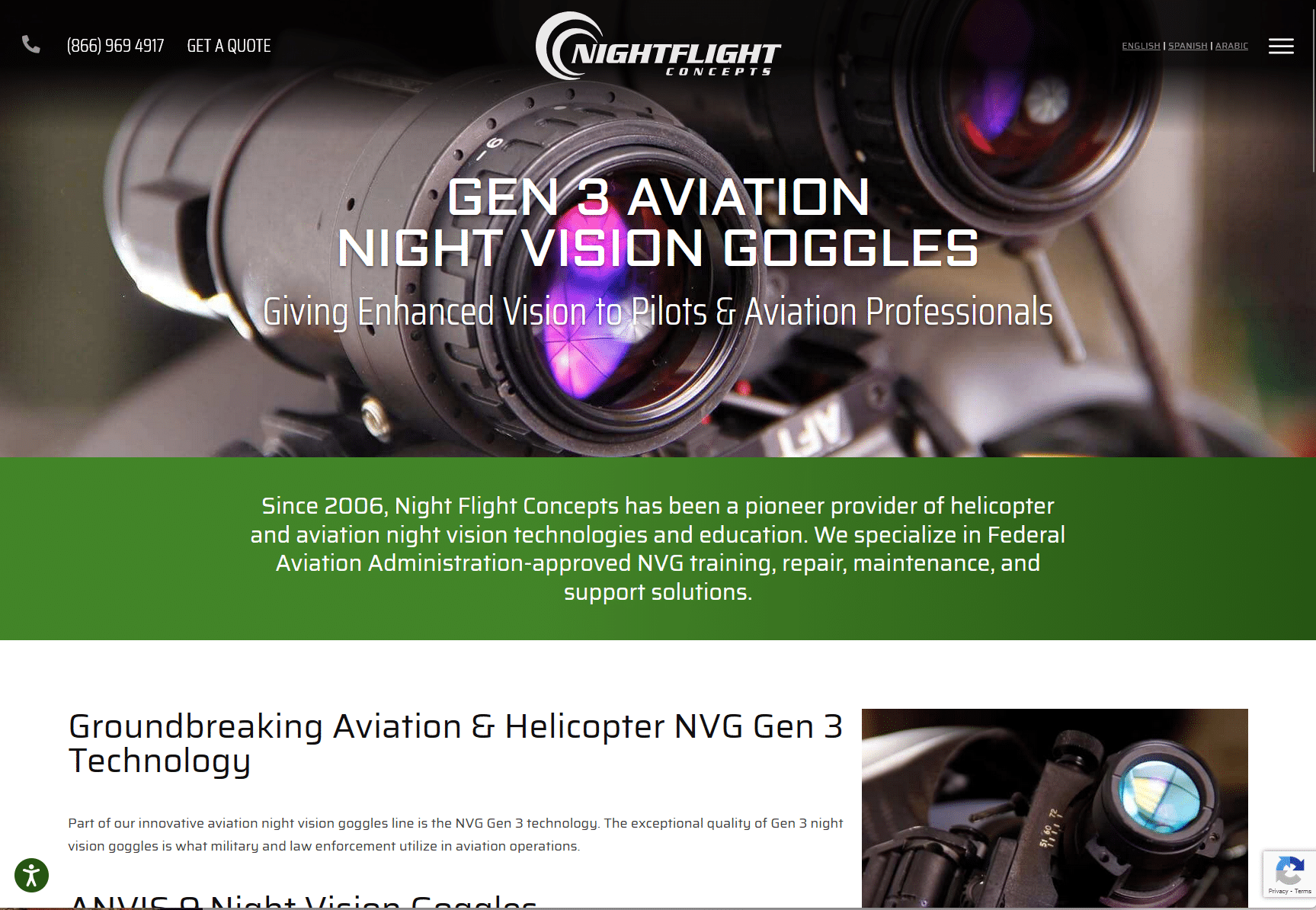
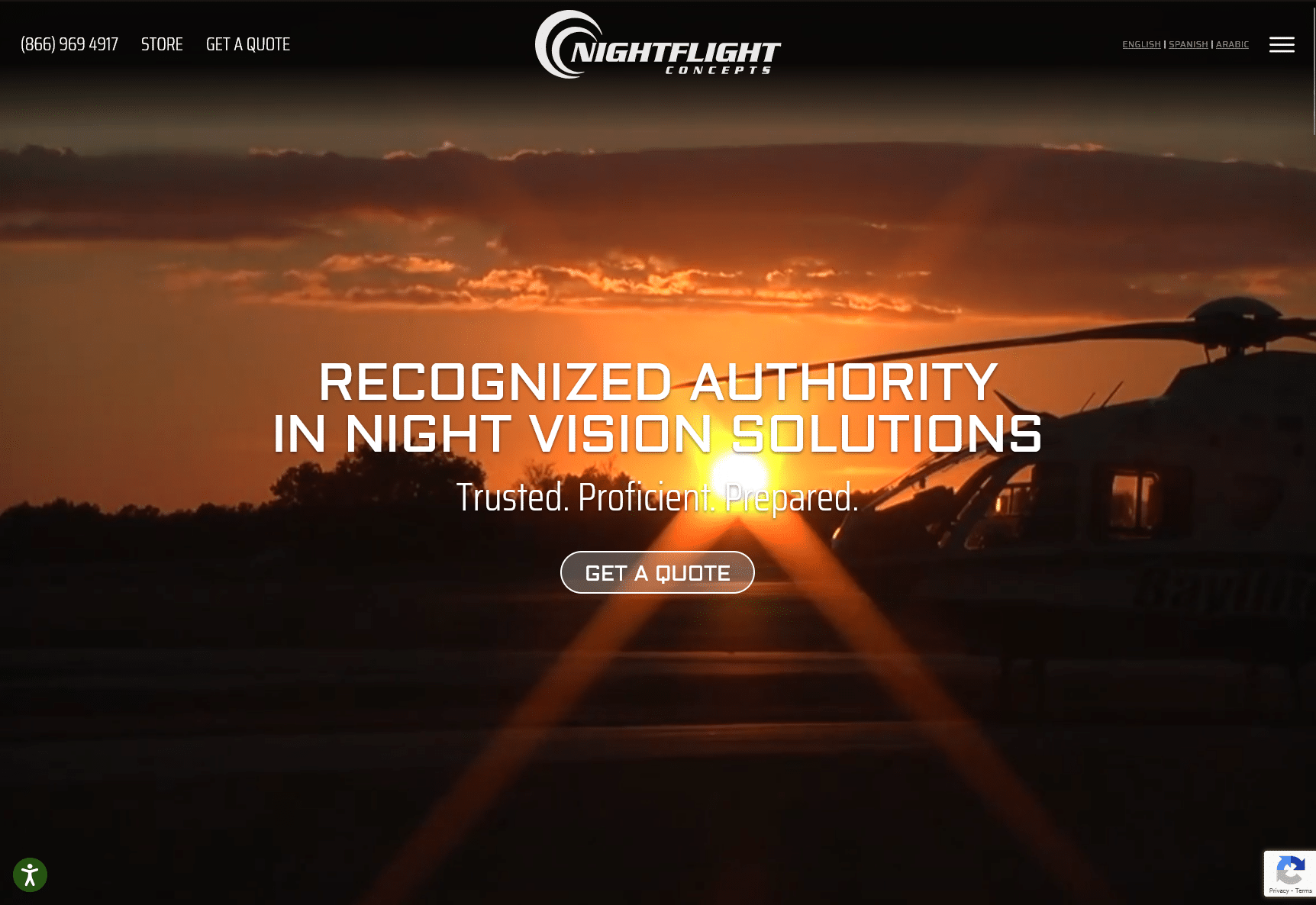
Most importantly, we made the site user-friendly. This meant a clear navigation menu to find content easily (including a language switcher for the Spanish and Arabic sections). Pages were structured with subheadings, bullet points, and visuals to avoid “walls of text” – no one wants to read a dense essay, especially not busy military officers or pilots. We placed prominent calls-to-action (CTAs) on every key page. For instance, a sticky “Contact Us” button that scrolls with the user, and inquiry forms on the side of pages where a user might be ready to reach out. We also set up the site to be mobile-responsive, knowing that some users (like a police helicopter unit commander) might be checking this out on a tablet in the field.
Building User-Friendly, Conversion-Focused Digital Experiences
Clear Aesthetics
Mobile-First
Intuitive Nav
SEO-Friendly
Conversion Elements Throughout: CTAs, Trust Badges, Testimonials
Trust-building elements were woven into the design as well. We showcased client testimonials (including a powerful quote from Night Flight’s president about the results, which we’ll mention later), certification logos, and an “About Us” snapshot on the homepage highlighting their years of experience. The goal was that anyone landing on this site would immediately feel, “This company is the real deal.” By the time design and content came together, we had a site that not only looked authoritative and engaging but was strategically crafted to convert visitors into leads.
Looks matter – and so does usability. The new site’s design gave Night Flight Concepts the image of an industry leader. But beyond aesthetics, we made deliberate design choices to support our SEO and conversion goals. A well-designed site makes visitors want to stay and explore, which sends positive signals to Google and increases the chances that those visitors turn into customers.
With designs approved and content in hand, our development team began building the site. This is where everything came together: the technical optimizations, the new content, the multilingual structure, and the sleek design. We developed the site with performance and SEO in mind at every step.
The site was built on a robust content management system that allowed for easy updates. We ensured the code was clean and lightweight. Large images were optimized or lazy-loaded (so they don’t slow down page load times). We also took care of technical SEO elements: generating an XML sitemap, implementing hreflang tags for the Spanish and Arabic pages, and setting up 301 redirects from old URLs to new ones so we wouldn’t lose any existing traffic or link equity.
One challenging aspect was making the site truly bilingual/trilingual. We set up separate sections of the site for each language and made it easy for Google to understand the relationships. For example, the Spanish training page had a tag pointing to the English version as its counterpart.

We also integrated a language switcher that remembered a user’s choice (so if someone in Colombia chose Spanish, they’d see the Spanish site on their next visit automatically). Testing was crucial here – we had teams of native speakers click through every page to make sure all translations displayed correctly and nothing was mixed up.
Building a Fast, SEO-Optimized, Multilingual Website
Lightweight code, optimized images, caching, sub-3s loads
Meta tags, alt text, XML sitemaps, schema markup
GA, Search Console, conversion goals, call tracking
Cross-browser testing, mobile responsiveness, SEO validation
Responsive layouts, tap targets, typography checks
Old → new URLs to preserve SEO equity
• Separate URL directories (/es/, /ar/)
• Hreflang tags for alternates
• RTL support for Arabic
• Native content localization
Just before launch, we ran speed tests and mobile-friendly tests to double-check our work. The new site scored high marks, loading in under 2 seconds and passing Google’s Core Web Vitals guidelines. Launch day itself went smoothly: we flipped the switch (right before Thanksgiving 2019, as it turned out) and watched as the new Night Flight Concepts website took off. Within hours, Google’s crawlers were indexing the new pages. We kept an eye on analytics and search console to ensure all signals were positive – they were. Now it was time to monitor performance and continue the momentum.
A successful launch is in the details. From site speed to hreflang to analytics, we made sure the new Night Flight Concepts website wasn’t just beautiful, but also technically primed to perform. When you launch a site that’s fast, user-friendly, and SEO-optimized from the ground up, you set yourself up for success from day one.
Just before launch, we ran speed tests and mobile-friendly tests to double-check our work. The new site scored high marks, loading in under 2 seconds and passing Google’s Core Web Vitals guidelines. Launch day itself went smoothly: we flipped the switch (right before Thanksgiving 2019, as it turned out) and watched as the new Night Flight Concepts website took off. Within hours, Google’s crawlers were indexing the new pages. We kept an eye on analytics and search console to ensure all signals were positive – they were. Now it was time to monitor performance and continue the momentum.
We worked with Night Flight to brainstorm topics for articles and guides. Many ideas came from the keyword research and from questions the client’s team frequently heard. For example, we wrote blog posts on “How to Prepare for Your First NVG Training Course,” “The Difference Between Green vs. White Phosphor Night Vision Goggles,” and “Night Vision for Aerial Firefighting: A Game Changer in Action.” These weren’t fluff pieces – they were in-depth, 1000+ word articles filled with insights, images, and even the occasional video clip or diagram. Essentially, we started turning the website into a knowledge hub for anyone interested in aviation night vision.
Crucially, we maintained a steady cadence of publishing.


We aimed for a new blog post every couple of weeks, and a more substantial guide or whitepaper every few months.
This steady drumbeat of content served multiple purposes: it gave Google new pages to index (which helps with SEO freshness), it allowed us to target an even wider array of keywords, and it kept visitors engaged (people started returning to read new content or signing up for a newsletter to stay informed).
Cultivating Authority by Consistently Delivering Valuable Content
How to prepare for your first course
→ Training PageWhat pilots should know
→ Equipment PageTop NVG care for flight ops
→ Service PageNight vision game changer
→ Industry PageFrom static brochure to living knowledge hub — positioning as the definitive industry expert
24
Articles/Year
100+
Keywords Targeted
∞
Growing Authority
Over time, this content strategy paid dividends. Not only did these pieces attract their own traffic (for example, the “NVG Training Preparation” post started ranking for various training-related queries), but they also bolstered the main pages. How? We interlinked blog posts with the core service pages, so if someone landed on a blog about NVG maintenance tips, that post would link to the actual NVG Maintenance Service page with a CTA like “Learn about our professional NVG maintenance programs.” This drove referral traffic internally and sent signals to Google that our service pages were backed by lots of relevant content depth on the site.
Content marketing is a marathon, not a sprint. By steadily publishing useful articles, Night Flight’s “keyword footprint” expanded dramatically. The site went from being a static brochure to a living resource center. This not only attracted more organic visitors (including those who weren’t searching for Night Flight by name or even aware of it yet), but it also educated and nurtured potential customers, making them more likely to convert when they did decide to reach out.
Even the best content can benefit from a boost. In the SEO world, that boost comes from backlinks – other websites linking to your site. High-quality backlinks act like votes of confidence, telling Google that your site is trustworthy and relevant. For a niche company like Night Flight Concepts, we needed to be creative in earning those links (it’s not like CNN or Forbes writes about helicopter NVG training every day!).
We pursued a targeted digital PR and link-building campaign. First, we identified industry directories and organizations related to aviation, defense, and law enforcement that would list training providers. We got Night Flight listed in several high-authority directories, which provided not only links but also referral traffic. Next, we crafted a couple of data-driven press releases – for example, announcing Night Flight’s expansion into offering training in the Middle East, and highlighting that they were one of the first in their industry to offer a fully translated Arabic website for NVG training. These press releases were distributed through newswire services and a few niche industry news sites picked them up, earning us some nice links.
Elevating Authority in the Eyes of Google Through Strategic Outreach
Aviation & law enforcement organization directories
Guest articles on industry blogs & publications
Infographics & whitepapers attracting natural links
Links from .edu, .gov, and respected industry sites
Strategic backlinks act as powerful votes of confidence, signaling to Google that Night Flight Concepts is the definitive authority in their niche
We also leveraged the content we created for outreach. If we wrote a comprehensive guide on something like “NVG Safety Tips for Law Enforcement Helicopter Units,” we would reach out to law enforcement blogs or aviation safety portals and let them know about our guide. A few of them ended up mentioning it and linking back as a resource. We wrote a guest article or two on reputable aviation blogs, with Night Flight’s CEO or trainer as the author, which subtly plugged their expertise and linked back to the site.


One of the most powerful wins was getting a link from a major defense contractor’s blog. This happened because Night Flight’s founder attended a conference and networked with some industry folks, which led to a collaboration piece where that big company’s blog mentioned Night Flight’s training in an article about NVG technology – and linked to us. These kinds of links are SEO gold.
Slowly but surely, Night Flight’s backlink profile grew. We weren’t chasing thousands of spammy links (quality over quantity!). Instead, we secured a few dozen high-quality links that really moved the needle. Google started seeing Night Flight Concepts as the authority we knew it was. The increased authority helped all our pages rank higher and more quickly than they would have without these backlinks.
Authority must be earned. We went out and earned it by getting Night Flight Concepts talked about and linked to across the web. These efforts, combined with on-site content quality, created a powerful synergy. Google’s algorithms began to see Night Flight not just as any site, but as the go-to expert in its niche. Even in a specialized industry, a handful of great backlinks can make a huge difference.
After months of hard work, the new site was live, content was flowing, and links were building up. But SEO is not a “set it and forget it” game – especially in the first year of a major overhaul. We entered the crucial phase of monitoring performance and making data-driven adjustments to keep the momentum going (and to catch any issues early).
The Performance report in GSC became our regular dashboard. It told us which queries our site was showing up for, how often (impressions), and the average positions. Over the months, we could see more and more keywords bubbling up. We paid special attention to queries where we were ranking on page 2 of Google (positions ~11–20). Those are low-hanging fruit – with a bit more optimization, we could push those onto page 1. For example, we noticed the site was sitting at #12 for “aviation NVG maintenance training.” In response, we beefed up the content on our Aviation NVG Maintenance Training page (adding an FAQ section addressing common maintenance questions) and built a couple of extra links to it. Sure enough, within a few weeks, that page crept onto page 1 and started getting more clicks.


We kept a close eye on Google Search Console (GSC). This free tool is a goldmine for SEO insights. Immediately after launch, we checked the Index Coverage report: were all our new pages getting indexed by Google? If any important pages were not indexed, we manually submitted them. We also watched for any crawl errors or warnings – none appeared (thanks to our careful development), but we remained vigilant. GSC also reported Core Web Vitals (site speed and user experience metrics). Our site was well in the green, but we monitored these in case any future changes slowed things down.
We also gleaned new content ideas from GSC. Sometimes the site would get impressions for unexpected phrases, indicating topics people were searching for that we hadn’t directly covered. For instance, we saw queries related to “night vision for firefighting helicopters.”
We had a page for Aerial Firefighters in the “Who We Serve” section, but it was thin. Seeing the interest, we expanded that page with more info specifically about how NVGs assist aerial firefighting operations, and we also wrote a blog post about a successful case of fire departments using NVGs. These tweaks and additions helped capture that emerging traffic.
Data-Driven Monitoring, Analysis & Strategic Improvements
Track indexing, crawl errors, Core Web Vitals, and performance metrics
Identify page 2 rankings for optimization opportunities and quick wins
Analyze bounce rates, engagement, and conversion paths with Google Analytics
Monitor Spanish and Arabic page performance across target markets
Small data-driven tweaks compound into significant gains - from identifying page 2 opportunities to defending top positions against competitors
On the user behavior side, we looked at Google Analytics data. We examined which pages had high bounce rates or low engagement. One interesting find: a lot of people were visiting the “About Us” page (likely checking credibility) but not clicking further. To address this, we added a prominent CTA on the About page – “Get a Free Consultation to Discuss Your NVG Needs” – and also included a few intriguing stats (like “Trusted by 50+ Agencies Worldwide”) to impress visitors. Over time, we saw engagement on that page improve, meaning fewer people left without exploring more.
We didn’t forget to monitor the international segments specifically. Using GSC’s country filter, we tracked how our Spanish pages were doing in Spanish-speaking countries and how the Arabic pages were doing in relevant regions. It was gratifying to see impressions and clicks coming from places like Mexico, Colombia, Saudi Arabia, and the UAE. When we saw those growing, we knew the translation effort was paying off. In fact, a few months in, Night Flight reported they received a couple of inquiries from new countries, directly attributing it to people finding the Spanish/Arabic content online. Huge win!

Lastly, we kept an eye on competitors periodically. If a competitor started ranking well for a term we wanted, we analyzed why. For example, one U.S. competitor published a big guide on aviation NVG safety that temporarily boosted their rankings. In response, we collaborated with Night Flight’s experts to create an even more comprehensive guide on that topic and promoted it. We were proactive in defending and expanding Night Flight’s top positions and not letting competitors outmaneuver us.
SEO success is an ongoing process. By closely monitoring data and being willing to adjust course, we ensured that Night Flight’s upward trajectory didn’t plateau. Small tweaks – guided by real user and search data – can lead to big gains over time. We treated the campaign like a living, breathing project, always looking for the next improvement or opportunity.
Even as we were executing the SEO overhaul, we saw an opportunity to jumpstart lead generation with Google Ads. SEO is incredibly powerful for long-term growth, but it can take months to reach full impact; Pay-Per-Click (PPC) ads can put you at the top of search results literally overnight. We didn’t want Night Flight Concepts to miss out on any potential clients during the SEO ramp-up period. So, in parallel with the site rebuild, we crafted a targeted Google Ads campaign focused on the highest-intent keywords from our research.
Accelerating results with targeted paid search campaigns
Focus on commercial keywords with strong purchase intent and qualified search volume
Optimize spend across campaigns with smart bidding for maximum ROI and lead generation
Monitor click-through rates, conversion tracking, and cost-per-acquisition metrics
Precision targeting for international markets and specific industry professionals
Generate instant visibility and qualified leads while organic SEO efforts build momentum
We started with a modest budget and laser-focused ad groups. For example, we created separate campaigns for different service areas: one for “NVG Training,” another for “NVG Maintenance,” and another for “NVG Equipment Sales.” This way, the ad copy could match exactly what the searcher was looking for in each category. We targeted not just the U.S., but also key international regions Night Flight wanted to reach.
That meant running ads in Spanish for Latin America and even exploring Arabic keywords for Middle Eastern markets. We wrote compelling, concise ad copy highlighting Night Flight’s unique value – headlines like “Night Vision Goggle Training – FAA Certified, Worldwide” – to attract clicks from serious prospects. And critically, we set up conversion tracking from day one: every time someone filled out the contact form or called the phone number from an ad, we recorded it. This allowed us to measure exactly which keywords and ads were driving leads.
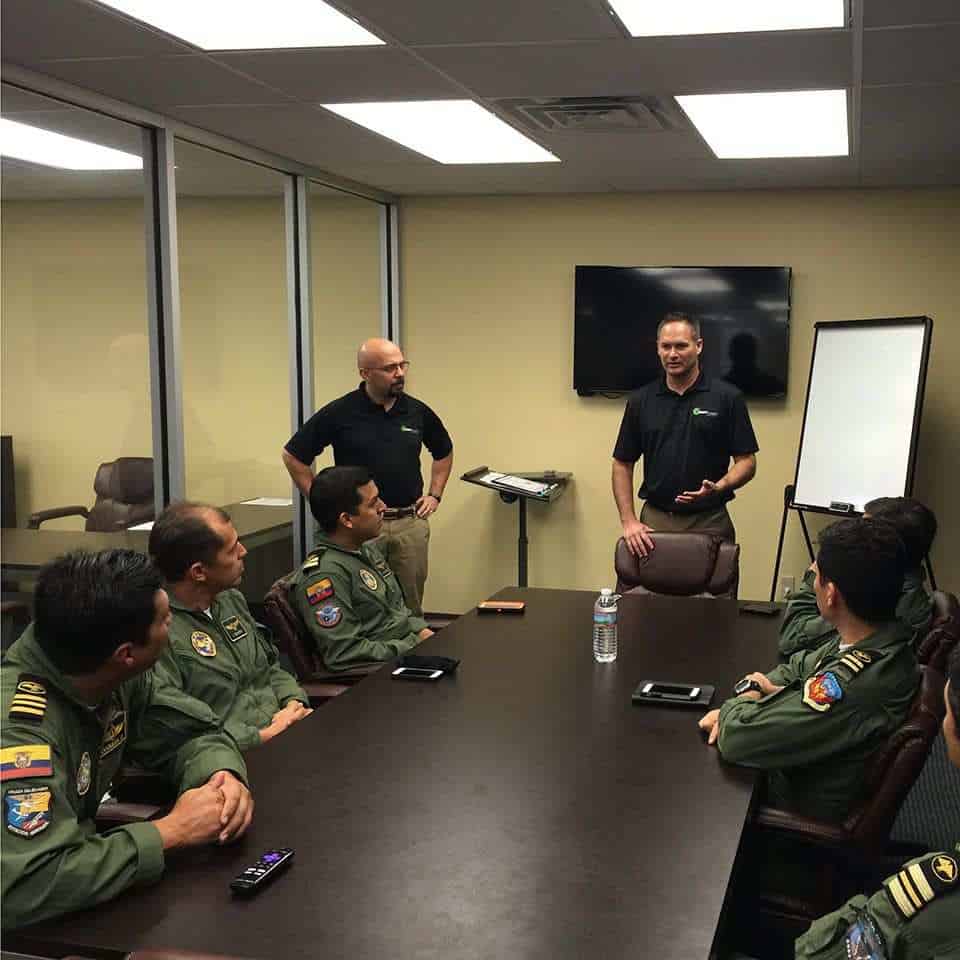
The effect was immediate. Within the first week of launching the PPC campaign, inquiries started coming in from places Night Flight had never reached before. A police aviation unit in South America found them through a Spanish ad; a search-and-rescue pilot in the Middle East clicked an ad triggered by an Arabic search query. Night Flight was suddenly visible at the top of Google for the most important terms, even while our SEO efforts were still climbing the ranks organically. In the first year alone, the Google Ads campaign generated 187 qualified leads. That was 187 opportunities that might have been lost had we waited passively for SEO to fully kick in. By using PPC as a complementary strategy, we ensured the business had a healthy pipeline of prospects immediately as our longer-term SEO work gained traction.
Don’t wait to start generating leads. SEO is invaluable for long-term growth, but PPC can deliver quick wins in the meantime. A well-targeted Google Ads campaign can put you in front of customers right away, even as your SEO is building up. The lesson? Use PPC as a strategic bridge to capture low-hanging fruit and high-intent prospects so you’re not leaving any opportunities on the table while organic traffic grows.
Getting an ad campaign live is just the beginning. Over the next months and years, we treated Night Flight’s Google Ads account like a living project – constantly analyzing and fine-tuning to squeeze more results from every dollar. We reviewed search query reports to find and eliminate irrelevant clicks (for example, excluding searches related to consumer-grade night vision devices that weren’t our target). We identified top-performing keywords – the ones consistently bringing in conversions – and ensured our bids were competitive on those, while dialing back or pausing keywords and ads that weren’t delivering. Essentially, we put every penny where it had the most impact.

We also expanded and improved the campaign as we gathered more data. If we noticed a particular model number, say “F4949 night vision goggles,” was generating leads, we’d spin that into its own ad group with highly specific ads and landing page tweaks to maximize its potential. We regularly A/B tested ad copy: even small changes like emphasizing “Military-Grade NVGs” versus “Aviation NVG Experts” in a headline could affect click-through and conversion rates. By continually testing, we kept improving our messaging. On the landing pages, we experimented with different headlines and contact form placements to boost the conversion rate (the percentage of ad-clickers who became leads). It was an ongoing cycle of measure -> tweak -> improve.

This ongoing optimization paid off big time. Over the years, the number of leads from PPC steadily climbed. Every tweak – a new negative keyword here, a more compelling ad headline there, an adjusted bid strategy to prioritize conversion value – helped increase Night Flight’s lead volume without wasteful spending. We also leveraged seasonal trends; for instance, we learned that many agencies budget for training in the fall, so we ramped up budgets during those high-interest months to capture that demand. Fast forward to today: in the last 12 months, our Google Ads campaigns brought in 411 leads, compared to 383 in the prior 12 months. And remember, in the first year it was 187. That’s well over double the annual leads we saw at the start of the campaign. Even better, the cost per lead actually went down as we scaled up – about 2.2% lower than it was two years ago. In an industry as specialized and competitive as this, achieving significantly more leads while slightly lowering the cost per lead is a huge win – it means we’re getting more efficient and effective with our ad spend over time.
Ongoing optimization turned paid search into a compounding engine
Eliminated irrelevant traffic & wasted spend
Ad copy & landing page optimization
Conversion value-based strategies
Targeted ads for F4949, ANVIS-9, etc.
Ramped up during peak buying periods
Tight keyword → ad → page alignment
Growing brand recognition from organic rankings lifted ad CTRs. Dual presence (paid + organic) signaled market leadership and boosted conversions by 35%.
One added benefit we noticed: as our SEO efforts made Night Flight’s name more well-known in the industry, the click-through rate on our ads improved too. People who had seen Night Flight appear in organic results started to recognize the name and were more likely to click on its ads, and vice versa. By occupying both the paid and organic top spots for many searches, Night Flight gave the impression of complete market dominance. This not only drove more clicks, but also instilled confidence in prospects – seeing the same company everywhere makes you think, “Wow, these guys are clearly the leaders.” It’s a one-two punch: SEO brought in a steady stream of free, long-term traffic, and PPC ensured we captured immediate leads and those who prefer clicking ads. Together, the two channels created a feedback loop of growing brand authority and lead generation.
Continuous improvement is the secret sauce for PPC success. Launching ads is not a one-and-done task – the real gains come from ongoing refinement. By tracking results, pruning what doesn’t work, and doubling down on what does, you can significantly increase your leads over time while actually reducing costs. Also, remember that SEO and PPC aren’t enemies; when run together strategically, they amplify each other. Dominating both organic and paid search results gives your business maximum exposure and credibility, as Night Flight happily discovered.
Twelve months after embarking on this journey, Night Flight Concepts’ online presence was unrecognizable compared to where we started. The transformation was nothing short of dramatic. Let’s recap the key outcomes of this year-long digital marketing overhaul:
From almost no visibility to 44 top-ranked keywords — overtaking their largest competitor in under 90 days.
Explosion in Keyword Rankings: The site went from barely ranking beyond its own brand name to dominating the search results for almost every relevant term in its niche. The new site was launched the day before Thanksgiving in 2019. On February 16, 2020, the unthinkable happened. Less than three months after the launch of the new site, it surpassed its most significant competitor (the market behemoth, over 100 times their size, who had dominated the search engines for years) by overtaking them in total keyword visibility on Google for the search terms we’d engineered into the site! And by twelve months after launch, Night Flight Concepts saw a 700% increase in first-position keyword rankings on Google, a 158% increase in first-page Google rankings, and a 118% increase in overall keyword visibility site-wide. And since that time, the progress has anything but slowed down. Night Flight Concepts now ranks for over 1,000 keywords on Google (up from essentially zero). Importantly, 44 of those keywords hold the coveted #1 position – meaning Night Flight is the very first result people see. When we first analyzed their super-narrow niche, we didn’t even think there were 44 relevant keywords worth going after! Search for “aviation night vision goggle training,” “ANVIS 9 goggles,” “helicopter NVG certification,” and dozens more – you’ll find Night Flight Concepts right at the top. They’re not just in the game; they’re leading it.
From virtually no search visits to thousands of monthly impressions and clicks — more than 35× more traffic every month.
Skyrocketing Organic Traffic: High rankings translated into a surge of potential customers visiting the site. By the end of year one, organic traffic had jumped by 1,500%! Similarly, monthly impressions (how many times the site showed up in search results) skyrocketed from about 1,600 to over 12,500 (an increase of 681%), while monthly clicks to the site exploded from an average of 4 to 144 (a 3,500% jump!). And all of that was just at the end of year one. What’s happened since? Unstoppable momentum. In the first 6 months of 2025 alone, the new site received 866,000 impressions in Google search results and 10,400 clicks. To put that into perspective, the old site had received fewer than 50 clicks per year from organic search. We’re talking thousands of targeted visitors now finding Night Flight Concepts every month, without counting a single dollar spent on ads.
Spanish and Arabic pages now rank at the top in multiple countries — driving new inbound inquiries from global markets.
International Reach: Thanks to the multilingual strategy, Night Flight is not just a U.S. success story – it’s global. Their Spanish and Arabic pages are ranking on the first page of Google in multiple countries. They’ve gained significant visibility in Latin America and the Middle East, leading to inquiries and partnerships abroad. For example, their Spanish content ranks #1 in several Latin American markets for terms like “entrenamiento de gafas de visión nocturna” (night vision goggle training in Spanish). The international ranking map shows a strong presence across North America, South America, and key parts of the Middle East. Night Flight Concepts has effectively expanded its market reach far beyond what traditional word-of-mouth or outbound sales outreach could ever do.
More prospects now reach out after repeatedly seeing Night Flight at the top of Google — boosting trust, visibility, and deal flow.
Business Growth and Credibility: While SEO metrics are great, what truly matters is business impact. Night Flight’s team reports that online (SEO + PPC) leads have multiplied. They’re regularly receiving contact form submissions from new prospects who found them via Google. Several large clients mentioned in kickoff calls that they “kept seeing Night Flight come up in search results” when researching NVG solutions – a testament to our dominance. In many cases, they saw Night Flight both in the paid ad slots and in the top organic results, reinforcing the company’s omnipresence. This kind of constant visibility not only drove direct leads but also bolstered Night Flight’s brand credibility. When a company keeps appearing as #1 everywhere you look, people assume (rightly so, in this case) that they’re the industry leader. Night Flight Concepts is now synonymous with aviation night vision training excellence online, just as they have been offline in their operations.
The proven 14-step methodology that took Night Flight Concepts from invisible to global leader
It’s important to emphasize: these results weren’t magic or luck. They were the product of a clear, well-executed strategy. Night Flight Concepts’ success confirms what we firmly believe: if you systematically check all the right boxes – from deep keyword research and competitor intel, to technically sound site development, to outstanding content creation in multiple languages, to launching strategic Google Ads campaigns, to smart link building, and to ongoing optimization – you can dramatically change a business’s trajectory in a year. Night Flight’s team also did their part, delivering top-notch service to the clients coming through, which in turn led to great reviews and word-of-mouth. That combination of an exceptional client offering and our digital strategy has proven unstoppable.
Reading about Night Flight Concepts’ journey, you might be thinking, “This sounds incredible, but can I really do all that on my own?” It’s normal to feel a bit overwhelmed – running your business is a full-time job, and implementing all these steps on top of that is a major challenge. That’s exactly why we’re here to help. We don’t just want to tell you about a blueprint in theory – we’d like to apply a customized version of it to your business.

This is a no-obligation, in-depth review where our team will assess your current online presence and identify the opportunities for you to achieve results like we did for Night Flight Concepts. Here’s what our free evaluation includes:
This is a no-obligation, in-depth review where our team will assess your current online presence and identify the opportunities for you to achieve results like we did for Night Flight Concepts. Here’s what our free evaluation includes:
Think of this evaluation as getting a free coaching session for your business’s online strategy. Whether you decide to implement the suggestions yourself or you’d like our team of experts at Rule Your Kingdom to assist you, you’ll come away with clarity on how to move forward and grow. We love educating business owners – you’ll understand why certain changes matter, not just get a list of tasks.
Remember, just 12 months before soaring to the top of Google and expanding globally, Night Flight Concepts was in the same position you might be in now – uncertain how to attract more leads online. The difference is that they took action and followed a proven process. You can do it too. Through the story above, you’ve seen what a dedicated SEO and digital marketing strategy can achieve, even in a specialized niche. The next step is up to you.

Ready to attract more qualified leads and take your business to new heights? Get your free website evaluation today. Let’s uncover your website’s potential and chart a path to extraordinary growth in the next year. Who knows – a year from now, we might be writing your success story here!
Don’t wait while your competitors continue to capture the customers that could have been yours. Kickstart your growth now with a free, no-pressure assessment. Get A Free Website Evaluation and let’s explore how your company can rule your< kingdom of online success.
Rule Your Kingdom • Law Firm SEO Specialists • Helping Attorneys Dominate Google Since 2011


7215 Bosque Blvd., Suite 125, Waco, Texas 76710 | Privacy Policy | Terms of Service | Disclaimer
